West Valley Gang Feud Heats Up Again Deseret News
| Mountain Meadows Massacre | |
|---|---|
| Mountain Meadows Massacre (Utah) | |
| Location | Mountain Meadows, Utah Territory, United States |
| Coordinates | 37°28′32″N 113°38′37″W / 37.4755°N 113.6437°W / 37.4755; -113.6437 Coordinates: 37°28′32″Due north 113°38′37″Westward / 37.4755°N 113.6437°West / 37.4755; -113.6437 |
| Engagement | September seven–xi, 1857 |
| Target | Members of the Baker–Fancher wagon train |
| Set on type | Mass murder |
| Weapons | Guns, Bowie knives |
| Deaths | 120–140 members of the Bakery–Fancher wagon train[ane] [a] |
| Injured | Around 17 |
| Perpetrators |
|
| Motive |
|
| Convicted | John D. Lee, leader in the local Mormon community and of the local militia |
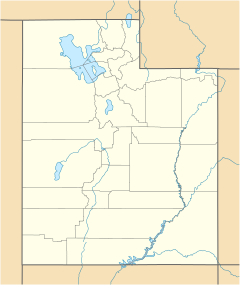

The Mountain Meadows Massacre (September 7–11, 1857) was a series of attacks that resulted in the mass murder of at to the lowest degree 120 members of the Baker–Fancher emigrant wagon train.[i] [a] The massacre occurred in the southern Utah Territory at Mountain Meadows, and was perpetrated by Mormon settlers belonging to the Utah Territorial Militia (officially chosen the Nauvoo Legion), together with the Southern Paiute Native Americans. The wagon railroad train, made upwardly mostly of families from Arkansas, was leap for California, traveling on the Old Spanish Trail (trade road) that passed through the Territory.
After arriving in Common salt Lake Metropolis, the Baker–Fancher political party made their manner due south forth the Mormon Road, eventually stopping to rest at Mountain Meadows. As the political party was traveling west at that place were rumors virtually the party's behavior towards Mormons and war hysteria towards outsiders was rampant, and so while the emigrants were camped at the meadow, local militia leaders, including Isaac C. Haight and John D. Lee, made plans to set on the wagon railroad train. The leaders of the militia, wanting to give the impression of tribal hostilities, persuaded Southern Paiutes to bring together with a larger party of militiamen disguised as Native Americans in an set on. During the militia's beginning assault on the wagon railroad train, the emigrants fought dorsum, and a five-solar day siege ensued. Eventually, fear spread amid the militia'due south leaders that some emigrants had caught sight of the white men, likely discerning the actual identity of a majority of the attackers. As a result, militia commander William H. Dame ordered his forces to impale the emigrants. By this time, the emigrants were running low on water and provisions, and immune some members of the militia—who approached under a white flag—to enter their army camp. The militia members assured the emigrants they were protected, and after handing over their weapons, the emigrants were escorted away from their defensive position. Later walking a distance from the camp, the militiamen, with the help of auxiliary forces hiding nearby, attacked the emigrants. The perpetrators killed all the adults and older children in the group, in the end sparing only seventeen young children under the age of seven.[a]
Post-obit the massacre, the perpetrators buried some of the remains merely ultimately left most of the bodies vulnerable to wildlife and the climate. Local families took in the surviving children, with many of the victims' possessions and remaining livestock being auctioned off. Investigations, which were interrupted by the American Civil War, resulted in ix indictments in 1874. Of the men who were indicted, but John D. Lee was tried in a court of law. Afterward two trials in the Utah Territory, Lee was convicted by a jury, sentenced to death, and executed past Utah firing squad on March 23, 1877.
Historians attribute the massacre to a combination of factors, including state of war hysteria near a possible invasion of Mormon territory and Mormon teachings against outsiders, which were part of the Mormon Reformation period. Scholars debate whether senior Mormon leadership, including Brigham Young, directly instigated the massacre or if responsibility for it lay only with the local leaders in southern Utah.
History [edit]
Baker–Fancher party [edit]
In early 1857, the Baker–Fancher party was formed from several groups mainly from Marion, Crawford, Carroll, and Johnson counties in northwestern Arkansas. They assembled into a wagon train at Beller's Stand, due south of Harrison, to emigrate to southern California. The group was initially referred to as both the Baker train and the Perkins train, merely later referred to as the Baker–Fancher train (or party). It was named after "Colonel" Alexander Fancher who, having already made the journey to California twice before, had go its main leader.[3] By contemporary standards the Baker–Fancher party was prosperous, carefully organized, and well-equipped for the journey.[4] They were joined along the way by families and individuals from other states, including Missouri.[5] The grouping was relatively wealthy, and planned to restock its supplies in Salt Lake City, as did about wagon trains at the time.
Interactions with Mormon settlers [edit]
At the time of the Fanchers' inflow, the Utah Territory was organized as a theocratic republic under the leadership of Brigham Young, who had established colonies along the California Trail and the Sometime Spanish Trail. President James Buchanan had recently issued an gild to ship troops to Utah which led to rumors being spread in the territory about its motives. Young issued various orders that urged the local population to prepare for the inflow of the troops. Eventually Young issued a proclamation of martial constabulary.[six]
The Bakery–Fancher party was refused stocks in Common salt Lake City and chose to get out there and take the Old Castilian Trail, which passed through southern Utah.[7] In August 1857, the Mormon campaigner George A. Smith traveled throughout the southern part of the territory instructing the settlers to stockpile grain.[viii] While on his return trip to Salt Lake Metropolis, Smith camped near the Baker–Fancher party on August 25 at Corn Creek. They had traveled the 165 miles (266 km) due south from Salt Lake City, and Jacob Hamblin suggested that the carriage train go on on the trail and rest their cattle at Mountain Meadows, which had good pasture and was adjacent to his homestead.[9]

Christopher Kit Fancher (survivor of the Mountain Meadows massacre)
While nigh witnesses said that the Fanchers were in general a peaceful party whose members behaved well along the trail, rumors spread almost their supposed misdeeds.[10] U.S. Army Brevet Major James Henry Carleton led the get-go federal investigation of the murders, published in 1859. He recorded Hamblin's account that the train was alleged to have poisoned a spring near Corn Creek; this resulted in the deaths of 18 head of cattle and 2 or iii people who ate the contaminated meat. Carleton interviewed the father of a kid who allegedly died from this poisoned spring, and accepted the sincerity of the grieving father. But, he as well included a statement from an investigator who did non believe the Fancher party was capable of poisoning the spring, given its size. Carleton invited readers to consider a potential caption for the rumors of misdeeds, noting the general temper of distrust amidst Mormons for strangers at the time, and that some locals appeared jealous of the Fancher party's wealth.[11]
Conspiracy and siege [edit]
The Baker–Fancher political party left Corn Creek and connected the 125 miles (201 km) to Mountain Meadows, passing Parowan and Cedar City, southern Utah communities led respectively by Stake Presidents William H. Matriarch and Isaac C. Haight. Haight and Dame were, in addition, the senior regional war machine leaders of the Mormon militia. As the Baker–Fancher political party approached, several meetings were held in Cedar City and nearby Parowan by the local Latter Solar day Saint (LDS) leaders pondering how to implement Young's annunciation of martial police.[12] On the afternoon of Lord's day, September 6, Haight held his weekly Stake High Quango meeting later on church services and brought up the issue of what to do with the emigrants.[thirteen] The plan for a Native American massacre was discussed, but not all the Quango members agreed it was the right approach.[13] The Council resolved to take no action until Haight sent a passenger, James Haslam, out the side by side twenty-four hours to carry an express to Table salt Lake City (a vi-mean solar day round trip on horseback) for Brigham Young'south advice, equally Utah did not however have a telegraph system.[xiii] Following the quango, Isaac C. Haight decided to transport a messenger s to John D. Lee.[xiii] What Haight told Lee remains a mystery, but because the timing it may have had something to do with Council'south conclusion to await for advice from Brigham Young.[14]
The dispirited Baker–Fancher party found water and fresh grazing for its livestock later on reaching grassy, mount-ringed Mount Meadows, a widely known stopover on the erstwhile Spanish Trail, in early on September. They anticipated several days of rest and recuperation there before the side by side 40 miles (64 km) would take them out of Utah. On September 7, the party was attacked by Mormon militiamen dressed every bit Native Americans and some Native American Paiutes.[15] The Baker–Fancher political party defended itself past encircling and lowering their wagons, wheels chained together, forth with digging shallow trenches and throwing dirt both below and into the wagons, which made a strong bulwark. Seven emigrants were killed during the opening attack and buried somewhere within the railroad vehicle encirclement. 16 more were wounded.[16] [17] The attack continued for five days, during which the besieged families had little or no access to freshwater or game food and their ammunition was depleted.[15] Meanwhile, organization among the local Mormon leadership reportedly broke downwardly.[12] Eventually, fear spread among the militia's leaders that some emigrants had caught sight of white men, and had probably discerned the identity of their attackers. This resulted in an lodge to kill all the emigrants,[xviii] with the exception of small children.[19]

Panorama of the expanse in 2009[xx]
Killings and aftermath of the massacre [edit]
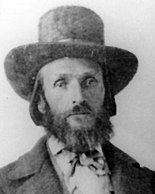
Maj. John H. Higbee. John D Lee and others said Higbee gave the command that began the killings.[21] Higbee later disavowed responsibility and blamed Lee for the massacre.[22]

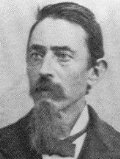
Maj. John D. Lee, constable, gauge, Indian Agent. The merely convicted participant, Lee conspired in advance with his immediate commander, Isaac C. Haight. He led the initial attack and falsely offered emigrants safe passage prior to their mile-long march to the field of the Massacre.

Philip Klingensmith, a Bishop in the church and a individual in the militia. He participated in the killings. Subsequently leaving the LDS Church he later turned country's show against his beau conspirators.
On Fri, September 11, 1857, two militiamen approached the Baker–Fancher party wagons with a white flag and were soon followed past Indian Agent and militia officer John D. Lee. Lee told the battle-weary emigrants that he had negotiated a truce with the Paiutes. Under Mormon protection, the wagon-train members would be escorted safely back to Cedar City, 36 miles (58 km) away, in substitution for turning all of their livestock and supplies over to the Native Americans.[23] Accepting this offer, the emigrants were led out of their fortification, with the adult men being separated from the women and children. The men were paired with a militia escort and when the indicate was given,[21] the militiamen turned and shot the male members of the Baker–Fancher political party continuing by their side. The women and children were then ambushed and killed past more militia that were hiding in nearby bushes and ravines. Members of the militia were sworn to secrecy. A programme was fix to arraign the massacre on the Native Americans. The militia did not kill small children who were deemed too young to relate what had happened. Nancy Huff, one of the seventeen survivors and only over iv years old at the time of the massacre, recalled in an 1875 statement that an eighteenth survivor was killed straight in front of the other children. "At the close of the massacre there was eighteen children still alive, ane girl, some 10 or twelve years old, they said was too big and could tell, so they killed her, leaving seventeen."[24] The survivors were taken in by local Mormon families.[25] Seventeen of the children were later reclaimed past the U.S. Ground forces and returned to relatives in Arkansas.[26] The treatment of these children while they were held by the Mormons is uncertain, only Captain James Lynch's statement of May 1859 stated that the surviving children were "in a nigh wretched condition, one-half starved, half naked, filthy, infested with vermin, and their eyes diseased from the roughshod neglect to which had been exposed." Lynch's July 1859 affidavit states "The children when nosotros offset saw them, were in a virtually wretched and deplorable condition; with little or no clothing, covered with filth and dirt."[27]
Leonard J. Arrington, founder of the Mormon History Association, reports that Brigham Young received the passenger, James Haslam, at his part on the same 24-hour interval. When he learned what was contemplated by the militia leaders in Parowan and Cedar City, he sent dorsum a letter stating the Baker–Fancher party was not to be meddled with, and should exist allowed to become in peace (although he best-selling the Native Americans would likely "do as they pleased").[17] [28] Young's letter arrived two days too late, on September 13, 1857.
The livestock and personal property of the Baker–Fancher party, including women'southward jewelry, vesture and bedstuffs were distributed or auctioned off to Mormons.[1] [29] Some of the surviving children saw vesture and jewelry that had belonged to their expressionless mothers and sisters subsequently being worn by Mormon women and the announcer J.H. Beadle said that jewelry taken from Mountain Meadows was seen in Table salt Lake City.[xxx]
Investigations and prosecutions [edit]
An early investigation was conducted by Brigham Young,[17] who interviewed John D. Lee on September 29, 1857. In 1858, Young sent a study to the Commissioner of Indian Diplomacy stating that the massacre was the work of Native Americans. The Utah War delayed whatsoever investigation by the U.S. federal government until 1859, when Jacob Forney and U.S. Regular army Brevet Major James Henry Carleton conducted investigations.[31] In Carleton'due south investigation, at Mount Meadows he found women's hair tangled in sage castor and the bones of children still in their mothers' artillery.[32] Carleton after said it was "a sight which tin never be forgotten." After gathering upward the skulls and bones of those who had died, Carleton'south troops buried them and erected a cairn and cross.[32]
Carleton interviewed a few local Mormon settlers and Paiute Native American chiefs and ended that at that place was Mormon involvement in the massacre. He issued a report in May 1859, addressed to the U.Due south. Banana Adjutant-General, setting forth his findings. Jacob Forney, Superintendent of Indian Affairs for Utah, also conducted an investigation that included visiting the region in the summer of 1859. Forney retrieved many of the surviving children of massacre victims who had been housed with Mormon families and gathered them upwards for transportation to their relatives in Arkansas. He ended that the Paiutes did not human action solitary and the massacre would non accept occurred without the white settlers,[31] while Carleton'south report to the U.Due south. Congress called the mass killings a "heinous crime",[11] blaming both local and senior church leaders for the massacre.
In March 1859, Gauge John Cradlebaugh, a federal estimate brought into the territory later on the Utah State of war, convened a grand jury in Provo apropos the massacre, but the jury declined any indictments.[33] Nevertheless, Cradlebaugh conducted a bout of the Mountain Meadows area with a military escort.[34] He attempted to arrest John D. Lee, Isaac Haight, and John Higbee, who fled before they could be found.[35] Cradlebaugh publicly charged Brigham Immature as an instigator to the massacre and therefore an "accessory earlier the fact."[34] Possibly as a protective mensurate against the mistrusted federal court organisation, Mormon territorial probate court judge Elias Smith arrested Immature under a territorial warrant, maybe hoping to divert whatever trial of Young into a friendly Mormon territorial courtroom.[36] Apparently because no federal charges ensued, Immature was released.[34]

The scene at Lee's execution by Utah firing squad on March 23, 1877. Lee is seated, adjacent to his coffin.

Justice At Last! – Leslie's Monthly Magazine article of 1877.
Farther investigations were cut short by the American Civil War in 1861,[37] just proceeded in 1871 when prosecutors obtained the affidavit of militia member Philip Klingensmith. Klingensmith had been a bishop and blacksmith from Cedar City; past the 1870s, still, he had left the church and moved to Nevada.[38]
Lee was arrested on Nov 7, 1874.[39] Matriarch, Philip Klingensmith, Ellott Willden, and George Adair, Jr. were indicted and arrested while warrants were obtained to pursue the arrests of four others (Haight, Higbee, William C. Stewart, and Samuel Jukes) who had gone into hiding. Klingensmith escaped prosecution by agreeing to testify.[40] Brigham Young removed some participants including Haight and Lee from the LDS Church in 1870. The U.Southward. posted bounties of $5000 ($107145[41] in nowadays-day funds) each for the capture of Haight, Higbee, Stewart, and Klingensmith.[42]
Lee's get-go trial began on July 23, 1875, in Beaver, earlier a jury of eight Mormons and four not-Mormons.[43] Ane of Lee's defense attorneys was Enos D. Hoge, a former territorial supreme court justice.[44] The trial led to a hung jury on Baronial 5, 1875. Lee'due south second trial began September 13, 1876, earlier an all-Mormon jury. The prosecution called Daniel Wells, Laban Morrill, Joel White, Samuel Knight, Samuel McMurdy, Nephi Johnson, and Jacob Hamblin.[45] Lee also stipulated, against advice of counsel, that the prosecution be allowed to re-employ the depositions of Immature and Smith from the previous trial.[46] Lee chosen no witnesses in his defense,[47] and was convicted.
Lee was entitled under Utah Territorial statute to choose the method of his execution from iii possible options: hanging, firing squad, or decapitation. At sentencing, Lee chose to be executed by firing team.[48] In his last words before his sentence was carried out at Mountain Meadows on March 23, 1877, Lee said that he was a scapegoat for others involved.[49] Brigham Young stated that Lee's fate was just, but not a sufficient blood atonement, given the enormity of the crime.[fifty]
Criticism and analysis of the massacre [edit]
Media coverage about the consequence [edit]

The cover of the August 13, 1859, event of Harper'due south Weekly illustrating the killing field every bit described by Brevet Major Carleton "one too horrible and sickening for linguistic communication to describe. Human skeletons, disjointed bones, ghastly skulls, and the hair of women were scattered in frightful profusion over a altitude of two miles." "the remains were not buried at all until after they had been dismembered by the wolves and the flesh stripped from the basic, and so only such bones were cached as lay scattered along nearest the road".
Initial published reports of the incident date dorsum at least to October 1857 in the Los Angeles Star.[51] [52] A notable report on the incident was made in 1859 past Carleton, who had been tasked by the U.Southward. Army to investigate the incident and coffin the nonetheless exposed corpses at Mountain Meadows.[11] The first menstruum of intense nationwide publicity about the massacre began effectually 1872 after investigators obtained Klingensmith's confession. In 1868 C. 5. Waite published "An Accurate History Of Brigham Young" which described the events.[53] In 1872, Marker Twain commented on the massacre through the lens of contemporary American public opinion in an appendix to his semi-autobiographical travel book Roughing Information technology.[54] In 1873, the massacre was given a full chapter in T. B. H. Stenhouse's Mormon history The Rocky Mount Saints.[55] The massacre itself as well received international attention,[56] [57] with diverse international and national newspapers likewise roofing John D. Lee's 1874[58] and 1877 trials too as his execution in 1877.[59] [60]
The massacre has been treated extensively by several historical works, kickoff with Lee's own Confession in 1877, expressing his opinion that George A. Smith was sent to southern Utah past Brigham Young to direct the massacre.[61]
In 1910, the massacre was the subject of a brusk book by Josiah F. Gibbs, who also attributed responsibility for the massacre to Young and Smith.[62] The outset detailed and comprehensive work using modern historical methods was The Mount Meadows Massacre in 1950 by Juanita Brooks, a Mormon scholar who lived near the area in southern Utah. Brooks constitute no prove of directly involvement by Brigham Young, but charged him with obstructing the investigation and provoking the attack through his rhetoric.
Initially, the LDS Church building denied any interest by Mormons, and was relatively silent on the issue. In 1872, it excommunicated some of the participants for their role in the massacre.[63] Since then, the LDS Church building has condemned the massacre and acknowledged interest by local Mormon leaders. In September 2007, the LDS Church published an article in its publications mark 150 years since the tragedy occurred.[64] [65]
Theories explaining the massacre [edit]
Historians have ascribed the massacre to a number of factors, including strident Mormon teachings in the years prior to the massacre, war hysteria, and alleged involvement of Brigham Young.
Strident Mormon teachings [edit]
For the decade prior to the Bakery–Fancher party's arrival at that place, Utah Territory existed equally a theodemocracy led by Brigham Immature. During the mid-1850s, Young instituted a Mormon Reformation, intending to "lay the axe at the root of the tree of sin and iniquity". In January 1856, Young said "the government of God, every bit administered here" may to some seem "despotic" considering "...judgment is dealt out against the transgression of the law of God."[66]
In addition, during the prior decades, the religion had undergone a period of intense persecution in the American Midwest. In particular, they were officially expelled from, and an Extermination Order was issued past Governor Boggs, of the state of Missouri during the 1838 Mormon War, during which prominent Mormon campaigner David W. Patten was killed in battle. After Mormons moved to Nauvoo, Illinois, the religion's founder Joseph Smith and his brother Hyrum Smith were killed in 1844. Following these events, faithful Mormons migrated west hoping to escape persecution. Withal, in May 1857, just months before the Mountain Meadows massacre, campaigner Parley P. Pratt was shot dead in Arkansas by Hector McLean, the estranged husband of Eleanor McLean Pratt, one of Pratt's plural wives.[67] [68] Parley Pratt and Eleanor entered a Angelic matrimony (under the theocratic law of the Utah Territory), but Hector had refused Eleanor a divorce. "When she left San Francisco she left Hector, and afterwards she was to country in a court of law that she had left him equally a married woman the night he drove her from their abode. Any the legal situation, she idea of herself equally an unmarried woman."[69]
Mormon leaders immediately proclaimed Pratt equally another martyr,[seventy] [71] with Brigham Young stating, "Nothing has happened so difficult to reconcile my heed to since the death of Joseph." Many Mormons held the people of Arkansas collectively responsible.[72] "It was in accordance with Mormon policy to hold every Arkansan answerable for Pratt'south death, just equally every Missourian was hated because of the expulsion of the church from that state."[73]
Mormon leaders were education that the 2nd Coming of Jesus was imminent – "...there are those at present living upon the earth who will live to meet the consummation" and "...we now show that his coming is near at hand".[74] Based on a somewhat ambiguous statement by Joseph Smith, some Mormons believed that Jesus would render in 1891[75] and that God would soon exact punishment against the United States for persecuting Mormons and martyring Joseph Smith, Hyrum Smith, Patten and Pratt.[76] In their Endowment ceremony, faithful early on Latter-24-hour interval Saints took an oath to pray that God would take vengeance against the murderers.[77] As a result of this oath, several Mormon apostles and other leaders considered it their religious duty to kill the prophets' murderers if they ever came beyond them.[78] The sermons, blessings, and private counsel past Mormon leaders simply before the Mount Meadows massacre can be understood equally encouraging individual individuals to execute God'south judgment against the wicked.[79]
In Cedar City, the teachings of church building leaders were particularly strident. Mormons in Cedar City were taught that members should ignore dead bodies and get almost their business.[lxxx] Col. William H. Dame, the ranking officeholder in southern Utah who ordered the Mountain Meadows massacre, received a patriarchal blessing in 1854 that he would "be called to act at the head of a portion of thy Brethren and of the Lamanites (Native Americans) in the redemption of Zion and the avenging of the blood of the prophets upon them that dwell on the globe".[81] In June 1857, Philip Klingensmith, some other participant, was similarly blessed that he would participate in "avenging the blood of Brother Joseph".[82] [83]
Thus, historians contend that southern Utah Mormons would have been particularly affected by an unsubstantiated[84] rumor that the Baker–Fancher railroad vehicle train had been joined by a group of eleven miners and plainsmen who chosen themselves "Missouri Wildcats", some of whom reportedly taunted, vandalized and "acquired trouble" for Mormons and Native Americans along the route (by some accounts claiming that they had the gun that "shot the guts out of Old Joe Smith").[85] They were besides affected past the report to Brigham Immature that the Baker–Fancher party was from Arkansas where Pratt was murdered.[86] It was rumored that Pratt's married woman recognized some of the Mountain Meadows political party as being in the gang that shot and stabbed Pratt.[87]
State of war hysteria [edit]
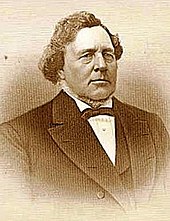
The Mount Meadows massacre was caused in office past events relating to the Utah War, an 1857 deployment toward the Utah Territory of the United States Army, whose arrival was peaceful. In the summer of 1857, withal, the Mormons expected an all-out invasion of apocalyptic significance. From July to September 1857, Mormon leaders and their followers prepared for a siege that could have ended up similar to the seven-year Haemorrhage Kansas problem occurring at the time. Mormons were required to stockpile grain, and were enjoined against selling grain to emigrants for use every bit cattle feed.[8] Equally far-off Mormon colonies retreated, Parowan and Cedar City became isolated and vulnerable outposts. Brigham Young sought to enlist the help of Native American tribes in fighting the "Americans", encouraging them to steal cattle from emigrant trains, and to bring together Mormons in fighting the approaching regular army.[88]
Scholars have asserted that George A. Smith'south tour of southern Utah influenced the conclusion to assail and destroy the Fancher–Baker emigrant train near Mount Meadows, Utah. He met with many of the eventual participants in the massacre, including West. H. Dame, Isaac Haight, John D. Lee and Chief Jackson, leader of a band of Paiutes.[89] He noted that the militia was organized and ready to fight and that some of them were eager to "fight and have vengeance for the cruelties that had been inflicted upon usa in the States."[90] Amid Smith's political party were a number of Paiute Native American chiefs from the Mountain Meadows area. When Smith returned to Salt Lake, Brigham Young met with these leaders on September i, 1857, and encouraged them to fight against the Americans in the anticipated clash with the U.Due south. Army. They were also offered all of the livestock then on the road to California, which included that belonging to the Baker–Fancher political party. The Native American chiefs were reluctant, and at least one objected they had previously been told not to steal, and declined the offering.[91]
Brigham Young [edit]

Historians debate the role of Brigham Young in the massacre. Immature was theocratic leader of the Utah Territory at the time of the massacre.
There is a consensus among historians that Brigham Immature played a role in provoking the massacre, at to the lowest degree unwittingly, and in concealing its bear witness after the fact. However, they debate whether Young knew well-nigh the planned massacre ahead of fourth dimension and whether he initially condoned it before later taking a stiff public stand against it. Immature's apply of inflammatory and violent language[92] in response to the Federal trek added to the tense atmosphere at the time of the attack. Following the massacre, Young stated in public forums that God had taken vengeance on the Baker–Fancher party.[93] Information technology is unclear whether Young held this view considering he believed that this specific group posed an actual threat to colonists or because he believed that the group was directly responsible for past crimes against Mormons. However, in Young'south only known correspondence prior to the massacre, he told the Church leaders in Cedar City:
In regard to emigration trains passing through our settlements, we must not interfere with them until they are beginning notified to keep away. You must not meddle with them. The Indians we expect volition practice equally they delight merely you should try and preserve good feelings with them. There are no other trains going due south that I know of[.] [I]f those who are there will leave permit them go in peace.[94]
According to historian MacKinnon, "After the [Utah] war, U.South. President James Buchanan implied that face-to-face communications with Brigham Young might have averted the conflict, and Young argued that a due north-south telegraph line in Utah could accept prevented the Mountain Meadows massacre."[95] MacKinnon suggests that hostilities could have been avoided if Immature had traveled eastward to Washington D.C. to resolve governmental problems instead of taking a five-calendar week trip north on the eve of the Utah War for church related reasons.[96]
A mod forensic assessment of a key affidavit, purportedly given past William Edwards in 1924, has complicated the contend on complicity of senior Mormon leadership in the Mountain Meadows massacre.[97] [98] Analysis indicates that Edwards'due south signature may have been traced and that the typeset belonged to a typewriter manufactured in the 1950s. The Utah State Historical Social club, which maintains the certificate in its athenaeum, acknowledges a possible connection to Mark Hofmann, a bedevilled forger and extortionist, via become-betwixt Lyn Jacobs who provided the society with the document.[99] [100]
Remembrances [edit]
The first monument for the victims was built ii years after the massacre, past Major Carleton and the U.S. Ground forces. This monument was a uncomplicated cairn built over the gravesite of 34 victims, and was topped by a big cedar cross.[101] The monument was found destroyed and the structure was replaced by the U.S. Army in 1864.[102] By some reports, the monument was destroyed in 1861, when Young brought an entourage to Mount Meadows. Wilford Woodruff, who afterward became President of the Church building, claimed that upon reading the inscription on the cross, which read, "Vengeance is mine, thus saith the Lord. I shall repay", Immature responded, "it should be vengeance is mine and I take taken a piddling."[103] [104] In 1932 residents of the surrounding area constructed a memorial wall around the remnants of the monument.[105]
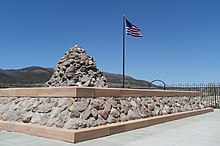
The 1999 burial site monument
Starting in 1988, the Mountain Meadows Association, composed of descendants of both the Baker–Fancher political party victims and the Mormon participants, designed a new monument in the meadows; this monument was completed in 1990 and is maintained past the Utah State Division of Parks and Recreation.[106] [107] In 1999 The Church of Jesus Christ of Latter-day Saints replaced the U.South. Regular army's cenotaph and the 1932 memorial wall with a 2d monument, which it at present maintains.[108] In Baronial 1999, when the LDS Church'due south construction of the 1999 monument had started, the remains of at least 28 massacre victims were dug upward by a backhoe. The forensic evidence showed that the remains of the males had been shot by firearms at close range and that the remains of the women and children showed evidence of blunt forcefulness trauma.[32] [109]

Memorial monument built at the site in 1990
In 1955, to memorialize the victims of the massacre, a monument was installed in the town foursquare of Harrison, Arkansas. On ane side of this monument is a map and short summary of the massacre, while the reverse side contains a listing of the victims.[110] In 2005 a replica of the U.S. Army's original 1859 cairn was built in the community of Carrollton, Arkansas,[111] the former canton seat of Carroll County, Arkansas.[112] information technology is maintained by the Mountain Meadows Monument Foundation.[111] [113]
In 2007, the 150th anniversary of the massacre was remembered by a anniversary held in the meadows. Approximately 400 people, including many descendants of those slain at Mount Meadows and Elder Henry B. Eyring of the LDS Church's Quorum of the Twelve Apostles attended this anniversary.[114] [115]
In 2011, the site was designated as a National Historic Landmark after joint efforts past descendants of those killed and the LDS Church.[116]
In 2014, archaeologist Everett Bassett discovered two stone piles he believes marking additional graves. The locations of the possible graves are on individual land and not at any of the monument sites endemic by the LDS Church. The Mountain Meadows Monument Foundation has expressed their want that the sites are conserved and given national monument status.[117] Other descendant groups have been more hesitant in accepting the sites as legitimate grave markers.[118]
Media detailing the massacre [edit]
- Massacre at Mountain Meadows, by Ronald West. Walker, Richard E. Turley, Glen M. Leonard (2008)
- House of Mourning: A Biocultural History of the Mount Meadows Massacre, by Shannon A. Novak (2008)
- Burying The Past: Legacy of The Mountain Meadows Massacre, a documentary film by Brian Patrick (2004)
- American Massacre: The Tragedy At Mountain Meadows, September 1857, by Sally Denton (2003)
- Claret of the Prophets: Brigham Young and the Massacre at Mount Meadows, by Will Bagley (2002)
- The Mountain Meadows Massacre, by Juanita Brooks (1950)
- Mountain Meadows. – an article originally published in the Cincinnati Gazette (July 21, 1875), then republished in the St. Louis Globe-Democrat(July 26, 1875). An affidavit of James Lynch'due south testimony taken in July 1859 about the human remains Lynch saw at Mountain Meadows in March and April 1858, well-nigh the living conditions of the child survivors of the Massacre during that time, and about the children's statements regarding the perpetrators of the Massacre. Lynch accompanied Dr. Jacob Forney, Superintendent of Indian Diplomacy, on an expedition to the area. The affidavit was given in forepart of Main Justice of the Utah Territory Supreme Court Delana R. Eckels on July 27, 1859, and sent by United states Ground forces officeholder Southward.H. Montgomery to Commissioner of Indian Affairs A.B. Greenwood in August 1859.
Works of historical fiction [edit]
- September Dawn film past Christopher Cain (2007) – The film is a fictional beloved story betwixt real characters who were involved in the massacre
- Red Water, novel by Judith Freeman (2002) – A novel about how the wives of John D. Lee take to come to terms with their hubby's actions
Come across also [edit]
- List of National Historic Landmarks in Utah
- National Register of Historic Places listings in Washington Canton, Utah
- Christian terrorism
- Haun'due south Mill massacre, an attack on Mormons
- Missouri Executive Order 44
- Mormonism and violence
- Common salt Creek Canyon massacre
- Religious terrorism
- Terrorism in the United states of america
- Domestic terrorism in the The states
References [edit]
Notes [edit]
- ^ a b c The verbal number of people who were in the carriage party is estimated by authors and historians to range from 120 to effectually 140. Bagley states that 70 people in the group were women and children known by name and that at to the lowest degree two-thirds of the wagon train consisted of women and children. The size of the party ebbed and flowed depending on where it was in its journeying west and so the verbal number of people in the wagon train at whatsoever given time and the exact number of people who were killed remains unknown (though Briggs states that 120 people were killed). The number of children who survived - those who were thought too young to remember the circumstances of their families' deaths - is more often than not best-selling by multiple sources to exist seventeen in number.[2]
Citations [edit]
- ^ a b c King, Gilbert (February 29, 2012). "The Aftermath of Mountain Meadows". Smithsonian.com. U.s.a. Government. Retrieved Feb 3, 2019.
- ^ Bagley 2002, pp. 56, 62–66, 388–389; Briggs 2006, p. 313; King 2012; Brooks 1991, pp. ten, 14, 101–105, 266: The figure of 120 to 140 expressionless that appears on Page 266, in Appendix 11 of Brooks, is taken verbatim from Deputy U.S. Marshal William H. Rogers' Statement, as printed in the February 29, 1860 edition of the Valley Tan newspaper
- ^ ; Finck (2018).
- ^ Bancroft (1889), p. 545; Linn (1902), Chap. XVI, 4th full paragraph.
- ^ Bancroft (1889), p. 544; Gibbs (1910), p. 12.
- ^ Shirts (1994), Paragraph 3.
- ^ Shirts (1994), Paragraph 2.
- ^ a b Smith (1875).
- ^ Little, James A. (1881). "Jacob Hamblin: A Narrative of His Personal Feel Fifth Book of the Faith-Promoting Serial (Chapter VI)". Gutenberg.com. Juvenile Teacher Function. Retrieved December 3, 2019.
When President Smith returned to Salt Lake Metropolis, Blood brother Thales Haskell and I accompanied him. On our way we camped over night on Corn Creek, twelve miles southward of Fillmore, with a political party of emigrants from Arkansas, traveling on what was then known as the southern road to California. They inquired of me virtually the route, and wrote the information down that I gave them. They expressed a wish to lay by at some suitable place to recruit their teams before crossing the desert. I recommended to them, for this purpose, the s terminate of the Mountain Meadows, three miles from where my family unit resided. ... Brother Haskell and I remained in Common salt Lake City 1 week, and then started for our homes in Southern Utah. On the style, we heard that the Arkansas company of emigrants had been destroyed at the Mountain Meadows,
- ^ Young, Brigham (Apr xxx, 1877). "Interview with Brigham Young". Deseret News (published May 23, 1877).
If y'all were to enquire of the people who lived hereabouts, and lived in the country at that fourth dimension, you would observe, ... that some of this Arkansas company ...boasted of having to helped to kill Hyrum and Joseph Smith and the Mormons in Missouri, and that they never meant to leave the Territory until like scenes were enacted here.
- ^ a b c Carleton (1902).
- ^ a b Shirts (1994), Paragraph 6.
- ^ a b c d Morrill (1876).
- ^ Walker, Ronald Due west., Richard Eastward. Turley, JR., Glen Grand. Leonard (2008). Massacre at Mount Meadows . Oxford University Press. p. 157. ISBN978-0-xix-516034-v.
- ^ a b Shirts (1994), Paragraph 8.
- ^ Penrose & Haslam (1885).
- ^ a b c Brigham Young: American Moses, Leonard J. Arrington, Academy of Illinois Press, (1986), p. 257
- ^ Walker, Ronald West. (2003). ""Relieve the emigrants", Joseph Clewes on the Mountain Meadows massacre (Joseph Clewes – eyewitness – Statement)". BYU Studies. 42 (1): 139–152.
...it was fabricated known by Higbee that the emigrants were to exist wiped out.
- ^ Walker, Ronald W.; Turley, Richard Due east.; Leonard, Glen M. (2008). Massacre at Mountain Meadows . New York: Oxford University Printing. pp. 174, 178–180. ISBN978-0-19-516034-v.
- ^ "Mount Meadows Massacre Site in Utah by Phil Konstantin". americanindian.net.
- ^ a b Lee (1877), p. 236.
- ^ Bagley (2002), pp. 326–329:"Without a Name of a Home - John M. Higbee"
- ^ Shirts (1994), Paragraph 9.
- ^ Huff Cates, Nancy Saphronia (September 1, 1875). "The Mount Meadow Massacre. Statement of one of the Few Survivors". Newspapers.com. Daily Arkansas Gazette. Retrieved September 13, 2021.
- ^ Bagley (2002), pp. 56:"Without a Proper noun of a Home - John M. Higbee"
- ^ Brooks (1991), pp. 101–105.
- ^ Turley, Richard Due east.; Johnson, Janiece L.; Carruth, LaJean Purcell, eds. (June 22, 2017). "James Lynch Affidavit". Mount Meadows Massacre: Collected Legal Papers, Initial Investigations and Indictments, Volume 1. University of Oklahoma Press. pp. 243–253. ISBN9780806158952 . Retrieved September 13, 2021.
- ^ Brigham Young to Isaac C. Haight, September. 10, 1857, Letterpress Copybook three:827–28, Brigham Young Office Files, LDS Church Archives.
- ^ Klingensmith, Philip (September 5, 1872). Written at Lincoln County, Nevada. Toohy, Dennis J. (ed.). "Mountain Meadows Massacre, Affidavit of Philip Klingensmith". Corinne Journal Reporter. Vol. 5, no. 252. Corinne, Utah (published September 24, 1872). p. 1. Retrieved February eleven, 2019 – via Utah Digital Newspapers, J. Willard Marriott Library, University of Utah.
- ^ Bagley (2002), pp. 174–175.
- ^ a b Forney, J. (May five, 1859). "Kirk Anderson Esq". Valley Tan (published May x, 1859). p. 2.
–Forney, J. (May 5, 1859). "Visit of the Superintendent of Indian Diplomacy to Southern Utah". Deseret News (published May 11, 1859). p. 1. - ^ a b c Fisher, Alyssa (September sixteen, 2003). "The Mountain Meadows Massacre". Archeology. Archaeological Plant of America. Retrieved February 4, 2019.
- ^ Cradlebaugh, John (March 15, 1859). Anderson, Kirk (ed.). "Charge (Orally delivered by Hon. John Cradlebaugh to the Grand Jury, Provo, Tuesday, March 8, 1859)". Valley Tan. p. iii – via Utah Digital Newspapers, J. Willard Marriott Library, University of Utah.
–Cradlebaugh, John (March 29, 1859). Anderson, Kirk (ed.). "Belch of the G Jury". Valley Tan. p. three – via Utah Digital Newspapers, J. Willard Marriott Library, University of Utah.
–Carrington, Albert, ed. (April half dozen, 1859). "The Court & the Army". Deseret News. p. 2 – via Utah Digital Newspapers, J. Willard Marriott Library, University of Utah. - ^ a b c Bagley (2002), p. 225.
- ^ Bagley (2002), p. 226.
- ^ Bagley (2002), p. 234.
- ^ Brooks (1991), p. 133.
- ^ Briggs (2006), p. 315.
- ^ "John D. Lee Arrested", Deseret News, November 18, 1874, p. 16.
- ^ "Tragedy at Mountain Meadows Massacre: Toward a Consensus Account and Time Line". Archived from the original on July 26, 2011.
- ^ 1634–1699: McCusker, J. J. (1997). How Much Is That in Existent Money? A Historical Price Index for Utilize every bit a Deflator of Money Values in the Economy of the United States: Addenda et Corrigenda (PDF). American Antiquarian Order. 1700–1799: McCusker, J. J. (1992). How Much Is That in Existent Coin? A Historical Price Alphabetize for Utilise as a Deflator of Money Values in the Economy of the United states (PDF). American Antique Lodge. 1800–nowadays: Federal Reserve Bank of Minneapolis. "Consumer Toll Index (estimate) 1800–". Retrieved April xvi, 2022.
- ^ Bagley (2002), p. 242.
- ^ "The Lee Trial", Deseret News, July 28, 1875, p. five.
- ^ Orson Ferguson Whitney, Popular History of Utah (1916), p. 305.
- ^ Lee (1877), pp. 317–378.
- ^ Lee (1877), pp. 302–303.
- ^ Lee (1877), p. 378.
- ^ "Territorial Dispatches: the Sentence of Lee", Deseret News, October eighteen, 1876, p. 4.
- ^ Lee (1877), pp. 225–226.
- ^ Immature, Brigham (April 30, 1877). "Interview with Brigham Young". The Deseret News . Retrieved February four, 2019 – via Utah Digital Newspapers, J. Willard Marriott Library, Academy of Utah.
[After being asked past the interviewer if he believed in blood amende, Young replied] "I do, and I believe that Lee has not half atoned for his groovy crime"
- ^ Staff (1857).
- ^ Christian (1857).
- ^ Waite (1868).
- ^ Twain (1872).
- ^ Stenhouse (1873), pp. 424–458.
- ^ "The Massacre of the Hundred Emigrants by the Mormons". Newspapers.com. The Morning time Chronicle (London, England). Dec 4, 1857. Retrieved August thirty, 2021.
- ^ "Treacherous Massacre by Mormons". Newspapers.com. Liverpool Mercury (Liverpool, England). Apr 27, 1860. Retrieved August 30, 2021.
- ^ "Mount Meadow". Newspapers.com. Winfield Courier (Winfield, Kansas). December three, 1874. Retrieved Baronial 30, 2021.
- ^ "John D. Lee's Execution". Newspapers.com. Cincinnati Daily Star. March 24, 1877. Retrieved August xxx, 2021.
- ^ "John D. Lee". Newspapers.com. Green-Mountain Freeman. March 28, 1877. Retrieved August 30, 2021.
- ^ Lee (1877), p. 225.
- ^ Gibbs (1910), pp. 7–9, 42.
- ^ Bagley (2002), p. 273.
- ^ Turley, Richard E., Jr. (September 2007). "The Mount Meadows Massacre". Ensign (LDS magazine). Archived from the original on July 8, 2008. Retrieved March 26, 2020.
- ^ De Groote, Michael (September 11, 2008). "Writing 'Massacre at Mountain Meadows'". Mormon Times. Archived from the original on February 21, 2009.
- ^ Young, Brigham (January 27, 1856). "The Powers of the Priesthood Not More often than not Understood – The Necessity of Living past Revelation – The Abuse of Blessing". Volume of Abraham Project. Brigham Immature Academy. Retrieved February four, 2019.
Is the spirit of the government and rule hither despotic? In their use of the word, some may deem information technology so. It lays the ax at the root of the tree of sin and iniquity; judgment is dealt out against the transgression of the law of God. If that is despotism, so the policy of this people may be deemed despotic. But does not the government of God, as administered hither, give to every person his rights?
- ^ Eleanor McLean Pratt (May 12, 1857). "To the Honorable Judge of the Court, in the town of Van Buren, State of Arkansas, May 12, 1957 (Mrs. Pratt's Letter of the alphabet to the Judge)". The Latter-Day Saints' Millennial Star, Book 19. pp. 425–426. Retrieved February 10, 2019.
- ^ "Further Particulars of the Murder – To Brother Orson (A letter of the alphabet from Eleanor McLean Pratt)". The Latter-Day Saints' Millennial Star, Book xix. May 12, 1857. pp. 426–427. Retrieved February 10, 2019.
- ^ Pratt (1975), p. 233 [vi] "When she left San Francisco she left Hector, and later on she was to state in a courtroom of law that she had left him as a wife the night he drove her from their domicile. Whatever the legal state of affairs, she thought of herself every bit an unmarried adult female."
- ^ "Murder of Parley P. Pratt, One of the Twelve Apostles of The Church of Jesus Christ of Latter-day Saints". The Latter-mean solar day Saints' Millennial Star. Vol. 19. Retrieved February 11, 2019.
- ^ Pratt (1975), p. [16] "I die a firm laic in the Gospel of Jesus Christ equally revealed through the Prophet Joseph Smith ... I am dying a martyr to the faith."
- ^ Brooks (1991), pp. 36–37.
- ^ Linn (1902), pp. 519–520.
- ^ Young et al. (1845), pp. 2 & 5.
- ^ Erickson (1996), p. nine.
- ^ Grant, Jedediah One thousand. (Apr 2, 1854). "Fulfilment of Prophecy—Wars and Commotions". In Watt, 1000.D. (ed.). Periodical of Discourses. Vol. 2. Liverpool: F.D. & Southward.W. Richards (published 1855). pp. 148–49.
It is a stern fact that the people of the United States accept shed the claret of the Prophets, driven out the Saints of God,...consequently I await for the Lord to use His whip on the refractory son called 'Uncle Sam';...
- ^ Diary of Heber C. Kimball (December 21, 1845); Beadle (1870), pp. 496–497 (describing the oath prior to 1970 as requiring a "individual, immediate duty to avenge the expiry of the Prophet and Martyr, Joseph Smith"); George Q. Cannon (Daily Journal of Abraham H. Cannon, December 6, 1889, p. 205). In 1904, several witnesses said that the oath as it then existed was that participants would never finish to pray that God would avenge the blood of the prophets on this nation", and that they would teach this practice to their posterity "unto the third and 4th generation". Buerger (2002), p. 134 The oath was deleted from the anniversary in the early on 20th century.
- ^ Diary of Heber C. Kimball (December 21, 1845) (maxim that in the temple he had "covenanted, and volition never rest...until those men who killed Joseph & Hyrum have been wiped out of the earth"); George Q. Cannon (Daily Periodical of Abraham H. Cannon, December vi, 1889, p. 205) (stating that he understood that his Endowment in Nauvoo included "an oath against the murders of the Prophet Joseph as well every bit other prophets, and if he had ever met any of those who had taken a hand in that massacre he would undoubtedly have attempted to avenge the claret of the Martyrs").
- ^
- Quinn (1997), p. 247: quotes from "Diary of Daniel Davis, July viii, 1849", held in the LDS archives(A Mormon who listened to a sermon by Young in 1849 recorded that Young said "if any ane was catched stealing to shoot them expressionless on the spot and they should non be hurt for it"); Young (1856b), p. 247 (stating that a man would exist justified in putting a javelin through his plural wife caught in the human activity of infidelity, but anyone intending to "execute judgment...has got to have clean hands and a pure centre...else they had ameliorate let the matter alone");
- Young (1857b), p. 219 ("[I]f [your neighbor] needs assistance, assistance him; and if he wants salvation and it is necessary to spill his blood on the earth in society that he may be saved, spill it")
- Young (1855), p. 311 ("[I]n regard to those who accept persecuted this people and driven them to the mountains, I intend to see them on their own grounds...I volition tell you how it could be done, we could accept the same law they have taken, viz., mobocracy, and if whatever miserable scoundrels come here, cut their throats. (All the people said, Amen).")
- Quinn (1997), p. 260: Quote: "LDS leaders publicly and privately encouraged Mormons to consider information technology their right to kill antagonistic outsiders, common criminals, LDS apostates, and even true-blue Mormons who committed sins 'worthy of death'."
- ^ Encounter Alphabetic character from Mary L. Campbell to Andrew Jenson, Jan 24, 1892, LDS athenaeum, in Moorman & Sessions, Campsite Floyd and the Mormons, p. 142.
- ^ Run across Patriarchal blessing of William H. Dame, February 20, 1854, in Harold Westward. Pease, "The Life and Works of William Horne Dame", M.A. thesis, BYU, 1971, pp. 64–66.
- ^ See Patriarchal blessing of Philip Klingensmith, Anna Jean Backus, Mountain Meadows Witness: The Life and Times of Bishop Philip Klingensmith (Spokane: Arthur H. Clark Co., 1995), pp. 118, 124;
- ^ Scott, Malinda Cameron (1877). "Malinda (Cameron) Scott Thurston Degradation". Mountain Meadows Association. Retrieved February four, 2019.
- ^ It is uncertain whether the Missouri Wildcat group stayed with the dull-moving Baker–Fancher party afterwards leaving Salt Lake City. See Brooks (1991), p. xxi; Bagley (2002), p. 280 (referring to the "Missouri Wildcats" story equally "Utah mythology".
- ^ Mountain Meadows Massacre in Tietoa Mormonismista Suomeksi. Encounter PBS Episode four and UTLM Newsletters #88 and Williams, Chris (1993). "The Mount Meadows Massacre: An Aberration of Mormon Practise". Archived from the original on Oct 14, 2007.
- ^ Immature, Brigham (July 30, 1875). "Degradation, People five. Lee". Deseret News. Vol. 24, no. 27. Common salt Lake Metropolis (published August four, 1875). p. eight.
- ^ Stenhouse (1873), p. 431 (citing "Argus", an bearding correspondent to the Corinne Daily Reporter whom Stenhouse met and vouched for).
- ^ Lyman, Edward Leo (2004). The Overland Journeying from Utah to California: Wagon Travel from the Urban center of Saints to the City of Angels (Hardcover ed.). University of Nevada Printing. p. 130. ISBN978-0874175011 . Retrieved February 4, 2019.
- ^ Martineau, James H. (Baronial 22, 1857). "Correspondence: Trip to the Santa Clara". Deseret News. Vol. 9, no. v. Parowan, Utah Territory (published September 23, 1857). p. 3 – via Utah Digital Newspapers, J. Willard Marriott Library, Academy of Utah.
- ^ Lyman, Edward Leo (2004). The Overland Journey from Utah to California: Wagon Travel from the Urban center of Saints to the City of Angels (Hardcover ed.). University of Nevada Press. p. 133. ISBN978-0874175011 . Retrieved February 4, 2019.
- ^ Huntington (1857).
- ^ MacKinnon (2007), p. 57.
- ^ Bagley (2002), p. 247.
- ^ Brigham Young to Isaac C. Haight, 10 September 1857, Letterpress Copybook 3:827–28, Brigham Young Office Files, LDS Church Archives.
- ^ MacKinnon (2007), endnote p. 50.
- ^ MacKinnon (2007), p. 59.
- ^ De Groote, Michael (September 7, 2010). "Mount Meadows Massacre affirmation linked to Marker Hofmann". Deseret News . Retrieved June 15, 2020.
- ^ Jeffreys, Keith B. (2010). "Mountain Meadows Massacre Artifact Now Believed To Be A Fake". Free Enquiry magazine. Vol. 22, no. four. Archived from the original on August 18, 2005 – via keithjeffreys.com.
- ^ Smart, Christopher (September x, 2010). "Mountain Meadows affirmation Hofmann forgery?". Salt Lake Tribune.
- ^ "Probable Hofmann Forgery Uncovered" (Press release). The Utah Partitioning of State History. 2010.
- ^ Carleton (1902), p. 15.
- ^ Helm George F. Price (June viii, 1864). "Salt Lake and Fort Mojave Westward R Expedition, Camp No. 18, Mountain Meadow, Utah, May 25, 1864". Matrimony Vedette . Retrieved May 8, 2021 – via Utah Digital Newspapers, J. Willard Marriott Library, Academy of Utah.
- ^ Denton (2003), p. 210.
- ^ Scott G. Kenney, ed., Wilford Woodruff's Journal, 9 vols. (Salt Lake City: Signature Books, 1984), 5:577.
- ^ Shirts (1994), Paragraph thirteen "The about indelible was a wall which notwithstanding stands at the siege site. It was erected in 1932 and surrounds the 1859 cairn."
- ^ Shirts (1994), Paragraph 13.
- ^ "1990 MONUMENT". Mount Meadows Clan. Archived from the original on May ix, 2008. Retrieved May sixteen, 2010.
- ^ "1999 Mountain Meadows Monument". Mountain Meadows Association. Retrieved March 9, 2009.
- ^ Brown-Hovelt, Luscinia; Himelfarb, Elizabeth J. (November 30, 1999). "Mount Meadows Massacre". Archaeology. Archaeological Establish of America. Retrieved February 4, 2019.
- ^ Flickr. J. Stephen Conn'southward photostream. Mountain Meadows Massacre Monument (photograph). Retrieved March 9, 2009.
- ^ a b Stack, Peggy; Ravitz, Jessica (September 14, 2007). "Families of Mountain Meadows Massacre victims want crosses at site". The Salt Lake Tribune. Retrieved August 1, 2021.
- ^ "Carrollton (Carroll Canton)". Encyclopedia of Arkansas. Central Arkansas Library Organisation. Retrieved August 1, 2021.
- ^ Somashekhar, Sandhya (May twenty, 2012). "Mitt Romney's Mormon faith tangles with a quirk of Arkansas history". The Washington Mail . Retrieved August 1, 2021.
- ^ "Eyring expresses regret for pioneer massacre".
- ^ Ravitz, Jessica, LDS Church Apologizes for Mountain Meadows Massacre, Salt Lake Tribune; September 11, 2007.
- ^ Stack, Peggy Fletcher (June 30, 2011). "Mount Meadows now a national historic landmark". Table salt Lake Tribune . Retrieved July 4, 2011.
- ^ Osinski, Nichole (September twenty, 2015). "Archaeologist: Mountain Meadows Massacre graves found". The (St. George, Utah) Spectrum.
- ^ Osinski, Nichole (November 14, 2015). "Voices of the Mountain Meadows descendants". The Spectrum. St. George, Utah. Retrieved July 16, 2020.
Bibliography [edit]
- Bagley, Will (2002), Claret of the Prophets: Brigham Young and the Massacre at Mount Meadows, Norman, Oklahoma: University of Oklahoma Press, ISBN978-0-8061-3426-0 .
- Bancroft, Hubert Howe (1889). History of Utah, 1540–1886. The Works of Hubert Howe Bancroft. Vol. 26. History Visitor.
- Beadle, John Hanson (1870). "Affiliate VI. The Encarmine Period.". Life in Utah. Philadelphia: National Publishing. pp. 177–195. LCCN 30005377. LCC BX8645 .B4 1870. .
- Briggs, Robert H. (2006). "The Mount Meadows Massacre: An Belittling Narrative Based on Participant Confessions". Utah Historical Quarterly. Vol. 74, no. 4. pp. 313–333. Archived from the original on Oct 21, 2013.
- Brooks, Juanita (1991) [1st pub. 1950]. The Mountain Meadows Massacre (1st paperback ed.). Norman, Oklahoma: University of Oklahoma Press. ISBN978-0806123189. .
- Buerger, David John (2002). The Mysteries of Godliness: A History of Mormon Temple Worship (2d ed.). Salt Lake City: Signature Books. ISBN978-1-56085-176-nine.
- Carleton, James Henry (1902) [written 1859]. Special Report of the Mountain Meadow Massacre. Washington: Authorities Printing Function. .
- Christian, J. Ward (Oct 4, 1857). Hamilton, Henry (ed.). "Horrible Massacre of Arkansas and Missouri Emigrants (Letter to Thou.N. Whitman)". Los Angeles Star. San Bernardino (published October ten, 1857).
- Denton, Emerge (2003). American Massacre: The Tragedy at Mountain Meadows. New York: Alfred A. Knopf. ISBN978-0-375-41208-0. .
- Erickson, Dan (1996). "Joseph Smith'due south 1891 Millennial Prophecy: The Quest for Apocalyptic Deliverance". Journal of Mormon History. 22 (2): 1–34. JSTOR 23287437. .
- Finck, James (2018). "Mountain Meadows Massacre". Encyclopedia of Arkansas History & Culture. Petty Stone, Arkansas: Encyclopedia of Arkansas Project.
- Gibbs, Josiah F. (1910), The Mountain Meadows Massacre, Salt Lake Metropolis: Salt Lake Tribune, ISBN978-0-548-30943-8, LCCN 37010372, LCC F826 .G532 .
- Huntington, Dimick B. (1857). Journal. ISBN978-0-87328-181-two. .
- Lee, John D. (1877). Bishop, William Due west. (ed.). Mormonism Unveiled; or the Life and Confessions of the Late Mormon Bishop, John D. Lee. St. Louis, Missouri: Bryan, Brand & Co. ISBN978-1-4366-1518-1.
- Linn, William Alexander (1902). The Story of the Mormons: From the Engagement of their Origin to the Year 1901. New York: Macmillan. ISBN978-ane-4191-8411-6. (scanned versions).
- MacKinnon, William P. (2007). "Loose in the stacks, a half-century with the Utah War and its legacy" (PDF). Dialogue: A Journal of Mormon Thought. 40 (1): 43–81. Archived from the original (PDF) on March 4, 2009.
- Morrill, Laban (September 1876). "Laban Morrill Testimony—Witness for the Prosecution at 2nd Trial of John D. Lee September 14 to 20, 1876 (Mountain Meadows Massacre Trials (John D. Lee Trials) 1875–1876)". The Mountain Meadows Association. Archived from the original on October thirteen, 2018. Retrieved Feb xi, 2019.
- Penrose, Charles W.; Haslam, James Holt (1885). "Supplement to the lecture on the Mountain Meadows massacre. Of import additional testimony recently received". Salt Lake City: Printed at Juvenile Instructor Function. p. 40. .
- Pratt, Steven (1975). "Eleanor McLean and the Murder of Parley P. Pratt" (PDF). Brigham Young Academy Studies. 15 (2): 225–256 [i–27]. JSTOR 43040559.
- Quinn, D. Michael (1997). The Mormon Hierarchy: Extensions of Ability. Common salt Lake City: Signature Books. ISBN978-one-56085-060-1. .
- Malinda (Cameron) Scott Thurston Deposition published by Mountain Meadows Clan
- Shirts, Morris A. (1994). "Mountain Meadows Massacre". In Powell, Allan Kent (ed.). Utah History Encyclopedia. Salt Lake City, Utah: Academy of Utah Printing. ISBN0874804256. OCLC 30473917. Archived from the original on Baronial ix, 2013. Retrieved December 3, 2019.
- Smith, George A. (July 30, 1875). "Deposition, People v. Lee". Deseret News. Table salt Lake Metropolis (published August 4, 1875). p. one. .
- Staff (October 3, 1857). Hamilton, H (ed.). "Rumored Massacre on the Plains". Los Angeles Star. p. 2. .
- Stenhouse, T.B.H. (1873), "Chapter XLIII", The Rocky Mountain Saints: a Total and Consummate History of the Mormons, from the Offset Vision of Joseph Smith to the Last Courtship of Brigham Immature, New York: D. Appleton, pp. 424–458, LCCN 16024014, LCC BX8611 .S8 1873 .
- Twain, Mark (1872). "Appendix B, The Mountain Meadows Massacre". Roughing It. Hartford, Conn.: American Publishing. ISBN978-0-xix-515979-0. .
- Waite, C.Five. (Catharine Van Valkenburg) (1868). The Mormon Prophet and His Harem: Or, an Authentic History of Brigham Young, His Numerous Wives and Children. Chicago: J.S. Goodman & Co. ISBN978-0-665-37321-3. .
- Young, Brigham; Kimball, Heber C.; Hyde, Orson; Pratt, Parley P.; Smith, William; Pratt, Orson; Folio, John E.; Taylor, John; et al. (April half dozen, 1845). "Announcement of the Twelve Apostles of The Church building of Jesus Christ of Latter-day Saints". New York: LDS Church. .
- Young, Brigham (July 8, 1855), "The Kingdom of God", in Watt, One thousand.D. (ed.), Journal of Discourses, vol. 2, Liverpool: F.D. & Due south.W. Richards (published 1855), pp. 309–17 .
- Young, Brigham (March xvi, 1856b), "Instructions to the Bishops—Men Judged According to their Cognition—System of the Spirit and Torso—Idea and Labor to be Blended Together", in Watt, G.D. (ed.), Journal of Discourses, vol. iii, Liverpool: Orson Pratt (published 1856), pp. 243–49 .
- Young, Brigham (February 8, 1857b), "To Know God is Eternal Life—God the Father of Our Spirits and Bodies—Things Created Spiritually First—Amende by the Shedding of Claret", in Watt, G.D. (ed.), Journal of Discourses, vol. 4, Liverpool: S.W. Richards (published 1857), pp. 215–21 .
External links [edit]
- Mount Meadows Association
- Mountain Meadows Monument Foundation
- PBS Frontline documentary: The Mormons, Part 1, episodes 8 & 9: Mountain Meadows.
- The Mountain Meadows Massacre: A Bibliographic Perspective past Newell Bringhurst
- The states Role of Indian Affairs Papers Relating to Charges Against Jacob Forney. Yale Collection of Western Americana, Beinecke Rare Book and Manuscript Library.
Source: https://en.wikipedia.org/wiki/Mountain_Meadows_Massacre
0 Response to "West Valley Gang Feud Heats Up Again Deseret News"
Post a Comment