You Know Im Never Once Liked Arlington
/https://tf-cmsv2-smithsonianmag-media.s3.amazonaws.com/filer/Arlington-military-cemetery-631.jpg)
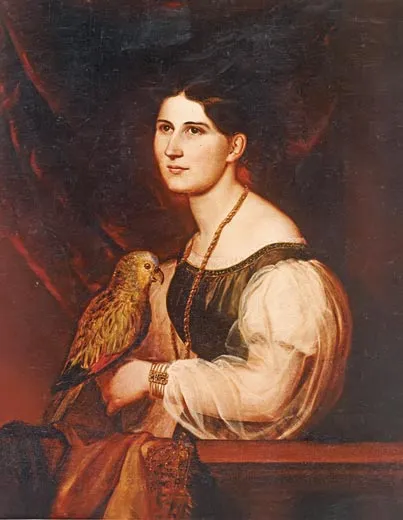
One afternoon in May 1861, a young Union Army officer went rushing into the mansion that commanded the hills across the Potomac River from Washington, D.C. "Yous must pack up all you value immediately and send it off in the morning time," Lt. Orton Williams told Mary Custis Lee, wife of Robert Eastward. Lee, who was away mobilizing Virginia'due south armed forces forces every bit the country hurtled toward the bloodiest state of war in its history.
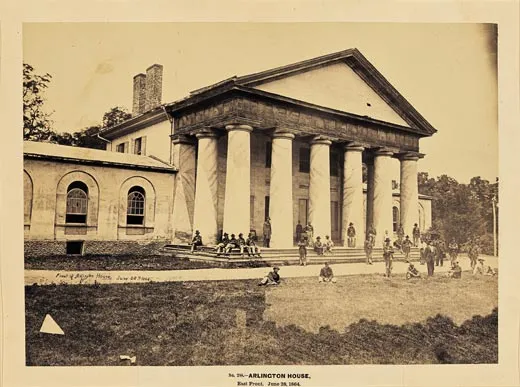
Mary Lee dreaded the thought of abandoning Arlington, the ane,100-acre estate she had inherited from her male parent, George Washington Parke Custis, upon his death in 1857. Custis, the grandson of Martha Washington, had been adopted by George Washington when Custis' male parent died in 1781. Showtime in 1802, as the new nation'due south majuscule took class beyond the river, Custis started building Arlington, his showplace mansion. Probably modeled after the Temple of Hephaestus in Athens, the columned house floated amid the Virginia hills as if it had been there forever, peering down upon the half-finished uppercase at its feet. When Custis died, Arlington passed to Mary Lee, his merely surviving child, who had grown up, married and raised seven children and cached her parents there. In correspondence, her married man referred to the place as "our beloved home," the spot "where my attachments are more strongly placed than at any other place in the world." If possible, his wife felt an even stronger attachment to the property.
On April 12, 1861, Confederate troops had fired on the federal garrison at Fort Sumter, Southward Carolina, prompting a number of states from the Deep South to join in rebellion. President Abraham Lincoln, newly installed in the White House, called upwardly 75,000 troops to defend the capital. As the spring unfolded, the forces drifted into Washington, fix up camp in the unfinished Capitol building, patrolled the metropolis'due south thoroughfares and scrutinized the Virginia hills for signs of trouble. Although officially uncommitted to the Confederacy, Virginia was expected to bring together the revolt. When that happened, Union troops would have to take command of Arlington, where the heights offered a perfect platform for arms—key to the defence force or subjugation of the capital. In one case the war began, Arlington was hands won. But then it became the prize in a legal and bureaucratic battle that would go along long after the guns savage silent at Appomattox in 1865. The federal regime was still wrestling the Lee family for control of the property in 1882, by which time it had been transformed into Arlington National Cemetery, the nation'due south near hallowed basis.
Orton Williams was not simply Mary Lee'southward cousin and a suitor of her daughter Agnes merely too individual secretary to General in Master Winfield Scott of the Union Regular army.
Working in Scott's office, he had no doubtfulness heard nearly the Union Army'south plans for seizing Arlington, which accounts for his sudden advent there. That May night, Mrs. Lee supervised some frantic packing by a few of the family'southward 196 slaves, who boxed the family silver for transfer to Richmond, crated George Washington's and G.West.P. Custis' papers and secured Full general Lee'southward files. Afterward organizing her escape, Mary Lee tried to go some slumber, only to exist awakened merely subsequently dawn by Williams: the Ground forces'due south advance upon Arlington had been delayed, he said, though it was inevitable. She lingered for several days, sitting for hours in her favorite roost, an arbor south of the mansion. "I never saw the state more beautiful, perfectly radiant," she wrote to her hubby. "The yellow jasmine in full flower and perfuming the air; just a decease like stillness prevails everywhere."
The general, stranded at a desk in Richmond, feared for his wife'southward condom. "I am very anxious about you," he had written her on April 26. "You have to motility, & brand arrangements to go to some point of condom....War is inevitable & there is no telling when it will outburst around you."
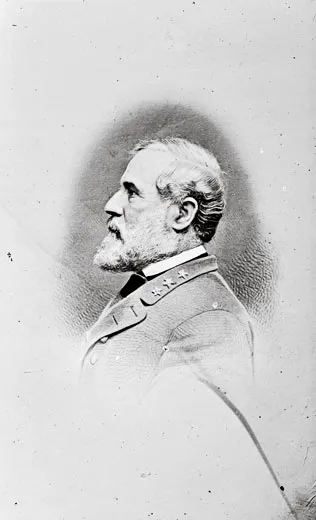
Past this time, he almost certainly knew that Arlington would exist lost. A newly deputed brigadier full general in the Amalgamated Army, he had made no provision to agree it by forcefulness, choosing instead to concentrate his troops some twenty miles southwest, about a railroad junction at Manassas, Virginia. Meanwhile, Northern newspapers such as the New York Daily Tribune trained their big guns on him—labeling him a traitor for resigning his colonel'due south committee in the Wedlock Regular army to get s "in the footsteps of Benedict Arnold!"
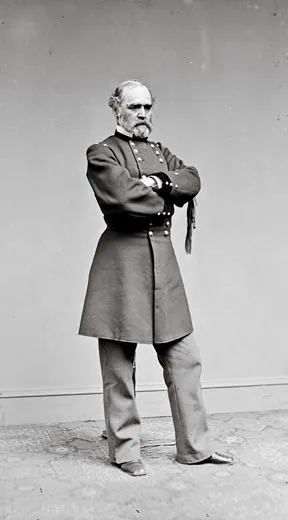
The rhetoric grew only more heated with the weather. Former Ground forces comrades who had admired Lee turned confronting him. None was more outspoken than Brig. Gen. Montgomery C. Meigs, a young man West Point graduate who had served amicably under Lee in the engineer corps just now considered him an insurgent. "No man who e'er took the oath to support the Constitution as an officeholder of our army or navy...should escape without loss of all his goods & civil rights & expatriation," Meigs wrote to his male parent. He urged that Lee as well as Gen. Joseph E. Johnston, who also had resigned from the federal Ground forces to join the enemy, and Amalgamated President Jefferson Davis "should be put formally out of the fashion if possible past sentence of death [and] executed if caught."
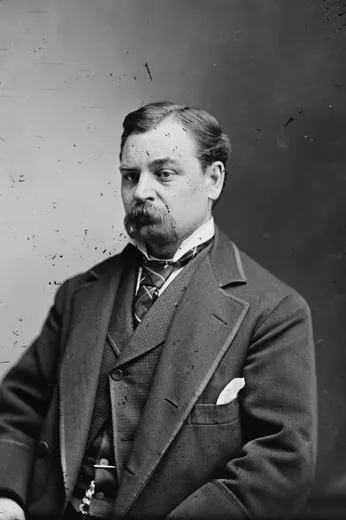
When Johnston resigned, Meigs had taken his chore as quartermaster general, which required him to equip, feed and transport a rapidly growing Spousal relationship Army—a task for which Meigs proved supremely suited. Vain, energetic, vindictive and uncommonly capable, he would back up his belligerent talk in the months and years ahead. His own mother conceded that the youthful Meigs had been "high tempered, unyielding, tyrannical...and very persevering in pursuit of anything he wants." Fighting for control of Arlington, he would go one of Lee's virtually implacable foes.
Past mid-May, even Mary Lee had to concede that she could non avert the impending conflict. "I would take profoundly preferred remaining at dwelling house & having my children around me," she wrote to one of her daughters, "simply equally it would profoundly increase your Father'due south anxiety I shall go." She made an eerily accurate prediction: "I fear that this volition be the scene of conflict & my beautiful home endeared past a k associations may become a field of carnage."
She took a final turn in the garden, entrusted the keys to Selina Gray, a slave, and followed her husband'south path down the estate'due south long, winding driveway. Like many others on both sides, she believed that the war would pass quickly.
On May 23, 1861, the voters of Virginia approved an ordinance of secession past a ratio of more than six to one. Within hours, columns of Marriage forces streamed through Washington and made for the Potomac. At precisely two a.k. on May 24, some 14,000 troops began crossing the river into Virginia. They advanced in the moonlight on steamers, on foot and on horseback, in swarms so thick that James Parks, a Lee family slave watching from Arlington, thought they looked "like bees a-coming."
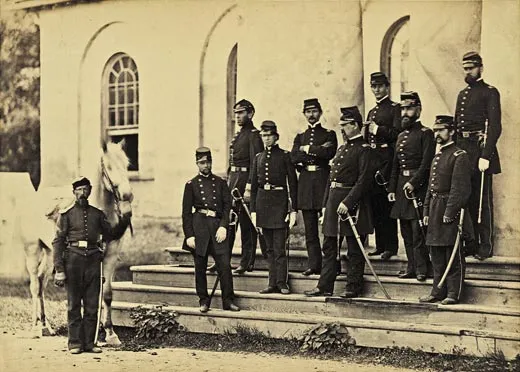
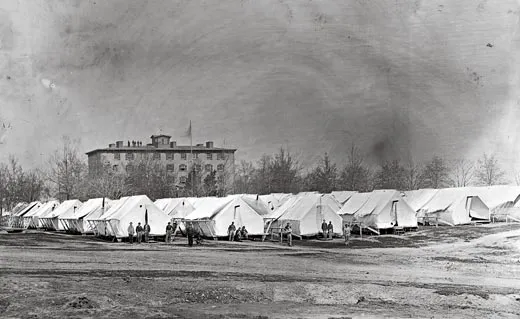
The undefended estate changed hands without a whimper. When the dominicus rose that morning, the place was teeming with men in blue. They established a tidy hamlet of tents, stoked fires for breakfast and scuttled over the mansion's wide portico with telegrams from the War Part. The surrounding hills were presently lumpy with breastworks, and massive oaks were felled to clear a line of burn down for artillery. "All that the best military skill could propose to strengthen the position has been washed," Frank Leslie's Illustrated Paper reported, "and the whole line of defenses on Arlington Heights may be said to be completed and capable of being held confronting any attacking force."
The set on never materialized, only the war'due south touch on was seen, felt and heard at Arlington in a thousand ways. Union forces denuded the estate's forest and absconded with souvenirs from the mansion. They built cabins and set up a cavalry remount station by the river. The Army as well took charge of the newly freed slaves who flocked into Washington after Lincoln'due south Emancipation Proclamation of 1863. When the government was unable to accommodate the one-time slaves in the upper-case letter, where thousands roughshod sick and died, one of Meigs' officers proposed that they be settled at Arlington, "on the lands recently abandoned past rebel leaders." A sprawling Freedmen'southward Village of 1,500 sprang to life on the estate, complete with new frame houses, schools, churches and farmlands on which former slaves grew food for the Marriage's state of war effort. "One sees more than poetic justice in the fact that its rich lands, so long the domain of the nifty full general of the rebellion, now afford labor and back up to hundreds of enfranchised slaves," a visiting journalist would written report in the Washington Contained in January 1867.
As the state of war had heated up in June 1862, Congress passed a police force that empowered commissioners to assess and collect taxes on real estate in "insurrectionary districts." The statute was meant not only to raise revenue for the war, merely also to punish turncoats like Lee. If the taxes were not paid in person, commissioners were authorized to sell the land.
Government levied a tax of $92.07 on the Lees' manor that year. Mary Lee, stuck in Richmond because of the fighting and her deteriorating health, dispatched her cousin Philip R. Fendall to pay the nib. But when Fendall presented himself earlier the commissioners in Alexandria, they said they would accept money but from Mary Lee herself. Declaring the property in default, they put it upwardly for sale.
The auction took identify on January 11, 1864, a day so cold that blocks of ice stopped boat traffic on the Potomac. The sole bid came from the federal government, which offered $26,800, well nether the estate'south assessed value of $34,100. Co-ordinate to the certificate of sale, Arlington's new owner intended to reserve the holding "for Regime use, for war, military machine, charitable and educational purposes."
Appropriating the homestead was perfectly in keeping with the views of Lincoln, Secretary of War Edwin M. Stanton, Gen. William T. Sherman and Montgomery Meigs, all of whom believed in waging full state of war to bring the rebellion to a speedy conclusion. "Make them and so ill of war that generations would laissez passer abroad before they would again appeal to information technology," Sherman wrote.
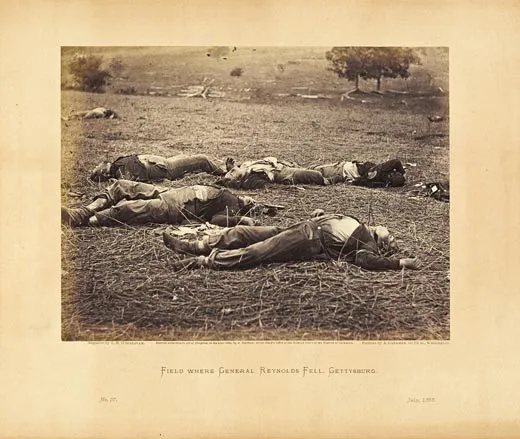
The war, of course, dragged on far longer than anyone expected. By the spring of 1864, Washington's temporary hospitals were overflowing with sick and dying soldiers, who began to fill local cemeteries but as General Lee and the Union commander, Gen. Ulysses Southward. Grant, began their blistering 40 Days' Campaign, exchanging blows from Virginia's Wilderness to Petersburg. The fighting produced some 82,000 casualties in but over a month. Meigs bandage about for a new graveyard to accommodate the rising tide of bodies. His heart fell upon Arlington.
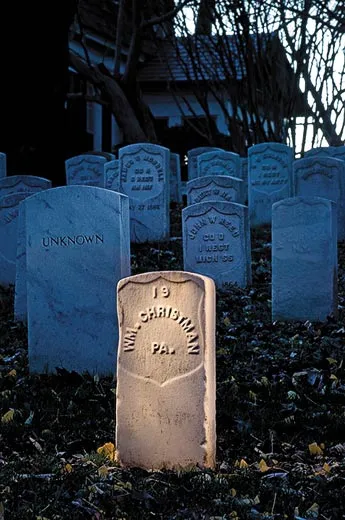
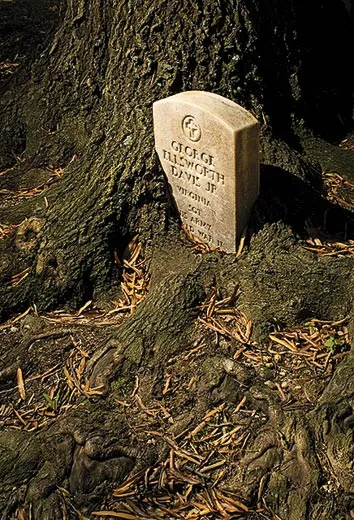
The beginning soldier laid to residue there was Pvt. William Christman, 21, of the 67th Pennsylvania Infantry, who was buried in a plot on Arlington'southward northeast corner on May thirteen, 1864. A farmer newly recruited into the Army, Christman never knew a solar day of combat. Similar others who would join him at Arlington, he was felled by disease; he died of peritonitis in Washington's Lincoln General Hospital on May xi. His trunk was committed to the globe with no flags flying, no bugles playing and no family unit or clergyman to come across him off. A simple pine headboard, painted white with black lettering, identified his grave, like the markers for Pvt. William H. McKinney and other soldiers too poor to exist embalmed and sent dwelling house for burial. The indigent dead shortly filled the Lower Cemetery—a proper name that described both its physical and social condition—across the lane from a graveyard for slaves and freedmen.
The adjacent month, Meigs moved to make official what was already a affair of do: "I recommend that...the state surrounding the Arlington Mansion, now understood to be the belongings of the United States, be appropriated every bit a National Military Cemetery, to exist properly enclosed, laid out and carefully preserved for that purpose," he wrote Stanton on June 15, 1864. Meigs proposed devoting 200 acres to the new graveyard. He likewise suggested that Christman and others recently interred in the Lower Cemetery should be unearthed and reburied closer to Lee'due south hilltop domicile. "The grounds about the Mansion are admirably adapted to such a use," he wrote.
Stanton endorsed the quartermaster's recommendation the same twenty-four hour period.
Loyalist newspapers applauded the nascency of Arlington National Cemetery, 1 of thirteen new graveyards created specifically for those dying in the Civil War. "This and the [Freedmen'south Village]...are righteous uses of the estate of the Rebel General Lee," read the Washington Morning Chronicle.
Touring the new national cemetery on the solar day that Stanton signed his order, Meigs was incensed to come across where the graves were existence dug. "It was my intention to have begun the interments nearer the mansion," he fumed, "but opposition on the role of officers stationed at Arlington, some of whom...did not like to have the dead buried near them, caused the interments to be begun" in the Lower Cemetery, where Christman and others were buried.
To enforce his orders—and to make Arlington uninhabitable for the Lees—Meigs evicted officers from the mansion, installed a war machine chaplain and a loyal lieutenant to oversee cemetery operations, and proceeded with new burials, encircling Mrs. Lee's garden with the tombstones of prominent Spousal relationship officers. The first of these was Capt. Albert H. Packard of the 31st Maine Infantry. Shot in the head during the Boxing of the 2d Wilderness, Packard had miraculously survived his journey from the Virginia front end to Washington's Columbian College Hospital, only to dice there. On May 17, 1864, he was laid to rest where Mary Lee had enjoyed reading in warm weather, surrounded past the scent of honeysuckle and jasmine. By the cease of 1864, some forty officers' graves had joined his.
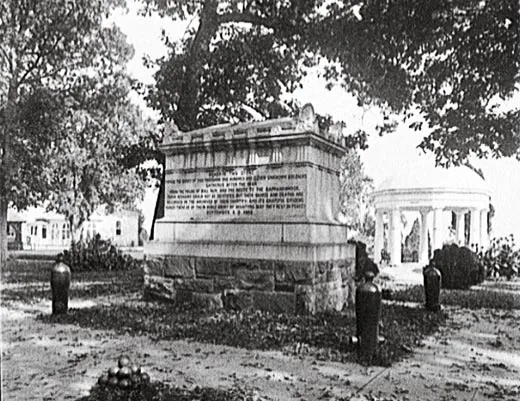
Meigs added others every bit soon as conditions allowed. He dispatched crews to scour battlefields for unknown soldiers near Washington. And so he excavated a huge pit at the end of Mrs. Lee'southward garden, filled it with the remains of two,111 nameless soldiers and raised a sarcophagus in their honor. He understood that past seeding the garden with prominent Union officers and unknown patriots, he would brand it politically difficult to disinter these heroes of the Republic at a later on engagement.
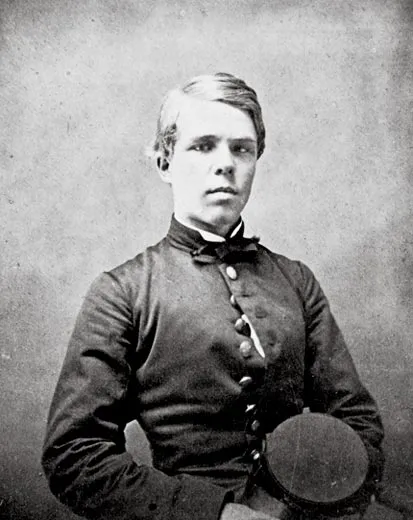
The last autumn of the state of war produced thousands of new casualties, including Lt. John Rodgers Meigs, one of the quartermaster's four sons. Lieutenant Meigs, 22, was shot on Oct 3, 1864, while on a scouting mission for Gen. Philip Sheridan in Virginia'south Shenandoah Valley. He was returned with solemn honors to Washington, where Lincoln, Stanton and other dignitaries joined his father for the funeral and burial in Georgetown. The loss of his "noble precious son" only deepened Meigs' antipathy toward Robert East. Lee.
"The rebels are all murderers of my son and the sons of hundreds of thousands," Meigs exploded when he learned of Lee's give up to Grant on April 9, 1865. "Justice seems not satisfied [if] they escape judicial trial & execution... by the authorities which they have betrayed [&] attacked & whose people loyal & disloyal they have slaughtered." If Lee and other Confederates escaped punishment considering of pardons or paroles, Meigs hoped that Congress would at least banish them from American soil.
Lee avoided the spectacle of a trial. Treason charges were filed against him but quietly dropped, almost certainly considering his quondam adversary, Grant, interceded on Lee'south behalf with President Andrew Johnson. Settling in Lexington, Virginia, Lee took over as president of Washington Higher, a struggling little school deep in the Shenandoah Valley, and encouraged quondam comrades to work for peace.
The Lees would spend the postwar years trying to retake possession of their estate.
Mary Lee felt a growing outrage. "I cannot write with composure on my ain cherished Arlington," she wrote to a friend. The graves "are planted upward to the very door without any regard to common decency....If justice & law are non utterly extinct in the U.Southward., I will take information technology back."
Her husband, all the same, kept his ambitions for Arlington subconscious from all but a few advisers and family unit members. "I have not taken any steps in the matter," he cautioned a Washington lawyer who offered to take on the Arlington case for free, "under the belief that at present I could accomplish no good." But he encouraged the lawyer to research the instance quietly and to coordinate his efforts with Francis Fifty. Smith, Lee's trusted legal adviser in Alexandria. To his elder blood brother Smith Lee, who had served as an officeholder in the Amalgamated navy, the general admitted that he wanted to "regain the possession of A." and particularly "to finish the burial of the dead which tin can but be done past its restoration to the family unit."
To gauge whether this was possible, Smith Lee made a hole-and-corner visit to the old estate in the autumn or winter of 1865. He ended that the identify could exist made habitable once again if a wall was built to screen the graves from the mansion. But Smith Lee made the mistake of sharing his views with the cemetery superintendent, who dutifully shared them with Meigs, along with the mystery visitor's identity.
While the Lees worked to reclaim Arlington, Meigs urged Edwin Stanton in early 1866 to make certain the government had sound title to the cemetery. The state had been consecrated past the remains buried there and could non be given back to the Lees, he insisted, striking a refrain he would repeat in the years ahead. Even so the Lees clung to the hope that Arlington might be returned to the family—if not to Mrs. Lee, and then to i of their sons. The former full general was quietly pursuing this objective when he met with his lawyers for the concluding time, in July 1870. "The prospect does not look promising," he reported to Mary. The question of Arlington'southward ownership was yet unresolved when Lee died, at 63, in Lexington, on Oct 12, 1870.
His widow continued to obsess over the loss of her home. Inside weeks, Mary Lee petitioned Congress to examine the federal claim to Arlington and estimate the costs of removing the bodies cached there.
Her proposal was bitterly protested on the Senate floor and defeated, 54 to iv. Information technology was a disaster for Mary Lee, but the contend helped to elevate Arlington's condition: no longer a potter's field created in the desperation of wartime, the cemetery was condign something far grander, a place senators referred to every bit hallowed basis, a shrine for "the sacred expressionless," "the patriot dead," "the heroic dead" and "patriotic graves."
The plantation the Lees had known became less recognizable each year. Many original residents of Freedmen's Village stayed on later the war, raising children and grandchildren in the lilliputian houses the Army had built for them. Meigs stayed on, too, serving equally quartermaster general for two decades, shaping the look of the cemetery. He raised a Greek-way Temple of Fame to George Washington and to distinguished Civil War generals by Mrs. Lee's garden, established a wisteria-draped amphitheater large plenty to suit 5,000 people for ceremonies and even prescribed new plantings for the garden'due south borders (elephant ears and canna). He watched the officers' section of the cemetery sprout enormous tombstones typical of the Gilded Age. And he erected a massive red arch at the cemetery'southward archway to award Gen. George B. McClellan, i of the Civil War's nigh popular—and to the lowest degree effective—officers. As was his habit, Meigs included his proper name on the arch; it was chiseled into the archway cavalcade and lettered in golden. Today, it is i of the outset things a company sees when approaching the cemetery from the due east.
While Meigs built, Mary Lee managed a farewell visit to Arlington in June 1873. Accompanied by a friend, she rode in a carriage for three hours through a landscape utterly transformed, filled with old memories and new graves. "My visit produced i skilful effect," she wrote later that week. "The change is so unabridged that I have not the yearning to become back in that location & shall be more content to resign all my right in it." She died in Lexington 5 months later, at age 65.
With her death, her hopes for Arlington lived on in her eldest son, George Washington Custis Lee, known every bit Custis. For him, regaining the estate was a matter of both filial obligation and self-interest: he had no inheritance beyond the Arlington property.
On April 6, 1874, inside months of his female parent'south funeral, Custis went to Congress with a new petition. Fugitive her inflammatory suggestion that Arlington be cleared of graves, he asked instead for an access that the property had been taken unlawfully and requested compensation for it. He argued that his female parent'southward good-faith attempt to pay the "insurrectionary tax" of $92.07 on Arlington was the same as if she had paid it.
While the petition languished for months in the Senate Judiciary Committee, Meigs worried that it would "interfere with the U.s.a.' tenure of this National Cemetery—a event to be avoided past all only ways." He demand not accept worried. A few weeks afterwards, the petition died quietly in commission, attended by no debate and scant notice.
Custis Lee might have given up so and at that place if not for signs that the hard feelings betwixt Northward and Southward were beginning to soften. Rutherford B. Hayes, a Spousal relationship veteran elected on the promise of healing scars from the Civil War, was sworn in as president in March 1877.
Hayes hardly had fourth dimension to unpack his bags before Custis Lee revived the campaign for Arlington—this time in court.
Asserting ownership of the property, Lee asked the Circuit Court of Alexandria, Virginia, to evict all trespassers occupying it as a result of the 1864 auction. As shortly as U.South. Attorney General Charles Devens heard about the adapt, he asked that the instance be shifted to federal court, where he felt the government would become a fairer hearing. In July 1877, the thing landed in the lap of Judge Robert W. Hughes of the U.S. Circuit Court for the Eastern District of Virginia. Hughes, a lawyer and newspaper editor, had been appointed to the bench past President Grant.
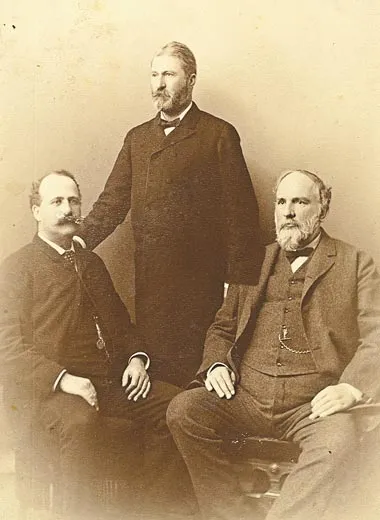
Subsequently months of legal maneuvering and arguments, Hughes ordered a jury trial. Custis Lee'south team of lawyers was headed by Francis Fifty. Smith, the Alexandrian who had strategized with Lee'south father years before. Their statement turned upon the legality of the 1864 tax auction. After a six-day trial, a jury found for Lee on January 30, 1879: by requiring the "insurrectionary taxation" to exist paid in person, the government had deprived Custis Lee of his property without due process of law. "The impolicy of such a provision of law is as obvious to me equally its unconstitutionality," Hughes wrote. "Its evil would be liable to fall not but upon disloyal only upon the most loyal citizens. A severe disease lasting only 90 or a hundred days would subject area the owner of land to the irreclaimable loss of its possession."
The government appealed the verdict to the Supreme Court—which ruled for Lee over again. On Dec 4, 1882, Associate Justice Samuel Freeman Miller, a Kentucky native appointed by President Lincoln, wrote for the 5 to 4 majority, holding that the 1864 tax auction had been unconstitutional and was therefore invalid.
The Lees had retaken Arlington.
This left few options for the federal government, which was now technically trespassing on private belongings. Information technology could carelessness an Ground forces fort on the grounds, roust the residents of Freedmen's Village, disinter most xx,000 graves and vacate the property. Or information technology could buy the estate from Custis Lee—if he was willing to sell it.
He was. Both sides agreed on a price of $150,000, the holding'south fair marketplace value. Congress quickly appropriated the funds. Lee signed papers conveying the title on March 31, 1883, which placed federal ownership of Arlington beyond dispute. The man who formally accustomed title to the property for the government was none other than Robert Todd Lincoln, secretarial assistant of war and son of the president and then oft bedeviled by Custis Lee'due south father. If the sons of such adversaries could bury past arguments, perhaps there was hope for national reunion.
The same yr the Supreme Court ruled in Custis Lee's favor, Montgomery Meigs, having reached the mandatory retirement historic period of 65, was forced out of the quartermaster'south task. He would remain active in Washington for another decade, designing and overseeing structure of the Pension Edifice, serving as a Regent of the Smithsonian Institution and every bit a fellow member of the National Academy of Sciences. He was a frequent visitor to Arlington, where he had buried his wife, Louisa, in 1879. The burials of other family members followed—amidst them his father, numerous in-laws and his son, John, reburied from Georgetown. Their graves, anchoring Row 1, Department ane of the cemetery, far outnumbered those of any Lee relatives on the estate.
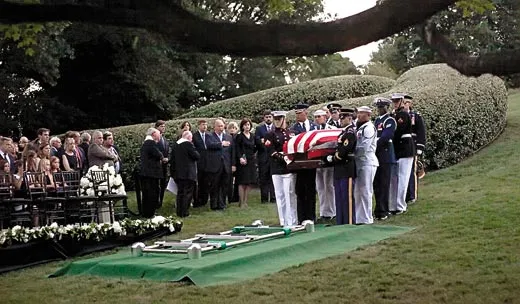
Meigs joined his family in January 1892, historic period 75, after a brief bout with the flu. He fabricated the concluding journey from Washington in fine style, accompanied by an Regular army band, flying flags and an award guard of 150 soldiers decked out in their best uniforms. His flag-draped caisson rattled across the river, up the long gradient to Arlington and across the meadow of tombstones he had so assiduously cultivated. With deadened drums marking time and guidons snapping in the arctic current of air, the funeral procession passed Mary Lee'due south garden and came to a halt on Meigs Bulldoze. The rifles barked their last salute, "Taps" sounded over the tawny hills and soldiers eased Montgomery C. Meigs into the basis at the heart of the cemetery he created.
Adapted from On Hallowed Ground, by Robert 1000. Poole. © 2009 Robert M. Poole. Published by Walker & Company. Reproduced with permission.

Source: https://www.smithsonianmag.com/history/how-arlington-national-cemetery-came-to-be-145147007/
0 Response to "You Know Im Never Once Liked Arlington"
Post a Comment